Tuesday, November 21, 2006

Loving and Hating


I wonder if the following Luther quote has any significance for participating in ministerial alliances, or "community" Thanksgiving worship services?
I abhor the assembly of evildoers and refuse to sit with the wicked. Psalm 26:5

We should have nothing to do with evildoers and wicked people. David said, “ I have nothing but hatred for them” (Psalm 139:22). The author of Psalm 1 praises believers who avoid them: “Blessed is the man who does not walk in the counsel of the wicked or stand in the way of sinners or sit in the seat of mockers” (v. 1). If you spend too much time with false teachers, you will eventually share in their false doctrine, lies, and errors. If you play with tar, you’re going to get dirty.

From Martin Luther, Faith Alone: A Daily Devotional, James C. Galvin, general editor.

Tuesday, October 31, 2006

An Interesting Merging of Reformation Day and Election Day

The Most Reverend Tom Chryst has posted this news story on his blog.

"If you should ask where to place the pope with the papists, either we shall say that they belong in this last group—for they attack and condemn many things they know are good and in harmony with the Word—or we shall simply classify them among the persecutors and opponents of sound doctrine, as the pope is called Antichrist for this reason."*

Here I stand, I can do none other! God help me!
And a very blessed Reformation Day to all!

*Luther, M. (1999, c1960). Vol. 2: Luther's works, vol. 2 : Lectures on Genesis: Chapters 6-14 (J. J. Pelikan, H. C. Oswald & H. T. Lehmann, Ed.). Luther's Works (Ge 12:18). Saint Louis: Concordia Publishing House.

Does Being Lutheran Matter? from Rev. Paul McCain

Does Being Lutheran Matter?
Thoughts for Reformation Day 2006Respectfully offered by Paul T. McCain

The movie "Luther" sparked renewed interest in the life and work of Martin Luther. The fact that Concordia Publishing House's movie companion book, Luther: Biography of a Reformer was received so enthusiastically indicates that, if only given a chance, people are eager to learn about Martin Luther and what it means to be and remain genuinely Lutheran. There seem to be three types of responses to the question, "Does being Lutheran matter?" One is, "Are you kidding me? You better believe that it matters! Let me tell you why!" Another response is a sort of "mental shrug" to the question, "Well, of course we want to be and remain Lutheran, that goes without saying, there's no real need to talk much about it though." And then, sadly, there is this response, "It doesn't matter. All that matters is being a Christian. We need to focus on what unites us rather than what divides us." As I watch and analyze events and trends in Christianity and Lutheranism, both in this country and around the world, I am more convinced than ever before of two things. First, being and remaining genuinely Lutheran matters more then ever, and second, the reasons why this is so are unclear at best to many people.

To be Lutheran is to be a person who says, "This is what God's Word, the Bible, teaches. This and nothing else is true and correct. This understanding and teaching and confession of the Gospel of Jesus Christ is the most accurate and most faithful to God's Word. This and none other. Nothing more, and nothing less, will do, for this is the truth." In our day and age these sorts of bold assertions are often met with angry responses, such as, "How dare you insist that Lutheranism is actually the true teaching of God's Word. How can you think you have the truth? All that matters is if a person is sincere about their faith in God." We live in a time when truth is viewed as something relative, impossible to know for sure. The attitude common today is reflected when we hear things like this, "I have my truth. You have your truth. As long as we respect our differences, that is all that matters." It seems today that the most important "truth" for many people is their profound doubt that truth can be known, and equally strong conviction that those who claim to know the truth are wrong.

Before we go further we need to clear up a common misconception. While insisting on the truth of Lutheranism, we can never allow ourselves to do so in an arrogant, haughty or self-righteous manner. People who are passionate about the truth of Biblical Lutheranism know that the Bible teaches often and clearly that we are all sinful human beings in need of God's constant mercy, which He so lavishly gives in Christ. To be truly Lutheran is to receive the gifts of God with humility, repentantly recognizing our great need. It is tempting for Lutherans to be proud and arrogant of their great heritage, but this is a terrible evil! To be Lutheran is to be always mindful of our great sin and our great need for a Savior. To be a Lutheran is to be a sinner calling out to fellow sinners, "Come and see!" Furthermore, we would never want anyone to think that we Lutherans are saying, "We, and we alone, are the only ones who will be in heaven. In fact, you can't be a Christian unless you are a Lutheran." Not so! Not at all. We realize that the Word of God is powerful and active, wherever and whenever it is heard, read or meditated on. There are many Christians in other denominations and churches. They are not Christians because of the errors in their churches, but in spite of those errors. Let's then have none say, "You Lutherans think you alone are Christians." We have never said that, we have never believed it, and we never will. The reason we insist on Lutheranism for everyone who will listen is we believe so passionately that it truly is the most correct and most accurate understanding of the Word of God.

Another point that confuses many people is the fact that there are so many different churches to choose from. It is an awful mess, so it seems. Yes, it can be confusing, but it really is not as complicated as some would think, or want to maintain. Up until the year 1054 there was basically one unified Christian church, distinct from a number of non-Christian or anti-Christian heretical groups. In 1054 the church divided into Eastern and Western Christianity. By the time of the late Middle Ages the Western Church, which had come to be known as the Roman Catholic Church, had reached a point of deep corruption, most importantly in what it believed, but also in the morals and life of the clergy and church leadership. In 1517 there began what we know today as the Reformation, when Martin Luther, a professor and monk in Wittenberg, Germany posted a series of "talking points" on the practice of selling "indulgences" by which people were led to believe they could buy forgiveness of sins, for their dead relatives in purgatory. A person has to decide is the Lutheran view of Christianity is correct, or the Roman Catholic view is correct.

After the Reformation, many groups developed from the teachings of persons other than Martin Luther, most notably, two men: Ulrich Zwingli and John Calvin, who did much of his work in Geneva. These two men and their writings gave rise to many churches that can be traced back to and grouped under the general category of "Reformed" churches. In America in the 19th and 20th century there arose many splinter groups from Reformed churches, these would include "Charismatic" and "Pentecostal" groups, along with groups that rejected all denominations and became, in effect, a denomination of their own, the so-called "non-denominational" churches. And so the question then becomes, "Is Lutheran theology correct, or Reformed theology correct?" So, is it Rome or Wittenberg. If Wittenberg, then is it Geneva or Wittenberg?" Once those decisions are made, the myriad of denominations today makes a lot more sense.
But there is an additional challenge unique to our century and more so the past half-century. Today, despite all their denominational differences and historic confessions, the vast majority of Christian churches in Protestantism have been nearly overwhelmed by the rise of liberal Christianity. This unites them more so than any other feature of their confession of faith. Historic differences are no longer regarded as divisive since these divisions were based on one group's understanding of the Biblical text as opposed to another group's understanding of the Bible. For example, the difference between Lutheran and Reformed views of the Lord's Supper are very important and based on very serious and clear differences in how the words Jesus spoke at the Last Supper are understood. Liberalism however regards the words of Jesus in the Bible as unreliable. It teaches that we can not be sure that what is recorded in the Bible is true and accurate, therefore, there is no point in being "dogmatic" about much of anything having to do with the Bible. Modern liberalism has swept through all Christian denominations, Lutheran Reformed, Protestant and Roman Catholic.

This impacts our question, "Does being Lutheran matter?" for we have to realize that there are many churches in the world today that claim to be Lutheran but have been nearly entirely overcome by liberal views of the Bible. Therefore, they have compromised away the distinct doctrinal position of Lutheranism. They are, in other words, Lutheran really in name only, more by way of tradition than by any real living doctrinal distinctiveness. They may still be fond of historic Lutheranism, but no longer insist that it, and it alone, is true and that other views of the Bible are in error. When we ask the question, "Does being Lutheran matter?" It is a question that must be asked first of those who still use the name Lutheran, but no longer insist on the exclusive truth claims of historic, genuine, authentic Lutheranism. Let's examine the world's largest Lutheran organization, the Lutheran World Federation.

Clear-headed analysis of what is happening in world Lutheranism reveals that the greatest threat to being and remaining genuinely Lutheran comes from groups that call themselves Lutheran! Let's think about the Lutheran World Federation, for instance. No organization in the world has done more in the past fifty years to deconstruct genuine Lutheranism than the Lutheran World Federation. It has tolerated, even encouraged, a loose and unfaithful understanding of the Holy Scriptures and the Lutheran Confessions, all the while ostensibly claiming a certain identity with them. The predecessor bodies that formed the Lutheran World Federation would not reject and throw out false teachers such as Rudolph Bultmann who worked to "demythologize" the New Testament, casting doubt on the words and deeds of Jesus. To this day the Lutheran World Federation pays mere lip service to the ancient Christian creeds, but tolerates in its midst churches whose pastors and theologians doubt, and even very brazenly and openly deny the most fundamental tenets of the Christian faith, casting doubt on the miracles of Jesus, His virgin birth, His bodily resurrection, and so forth! LWF member organizations have embraced the anti-Apostolic and anti-Scriptural practice of the ordination of women, abortion. The large Lutheran state churches are offering same-sex marriages. The LWF, despite its claim that it is Lutheran, does not even insist on absolutely faithfulness to the most basic of all the Lutheran confessions, Martin Luther's Small Catechism. The LWF, and most of its member churches, compromised and walked away from the Lutheran insistence on the Lord's Supper when it entered into all manners of "full communion" with Reformed churches that continue to this day to deny that the bread and wine in the Holy Communion are in fact the body and blood of Christ. The LWF leadership structure has embraced a compromise of the very heart of the Gospel itself with Rome, when it accepted the "Joint Declaration on the Doctrine of Justification" in which it allowed Rome to continue its formal anathema of the Biblical doctrine that we are saved by grace alone, through faith alone, apart from any works.

In our own country, we have seen the devastating consequences of this compromising view of Lutheranism in the Evangelical Lutheran Church in America. It is in full communion fellowship with the most outrageously liberal of one of the most outrageously liberal protestant churches in the world, the United Church of Christ. The UCC does not even insist that its member pastors confess the Holy Trinity! The disaster taking place in the Episcopalian Church in this nation merely is a portend for what the ELCA faces, which only recently had a prominent woman theologian officiate at a homosexual "wedding" service with two women and then shortly after a pastor in their midst do the same for a male couple. Because of the "Concordat" of full communion the ELCA has with the Episcopalian Church USA the newly consecrated homosexual bishop is now, de facto, also a bishop received and recognized by the ELCA. Within our own Synod there is the constant temptation on the part of some to bury their head in the sand and hope and pretend these situations are not taking place or that somehow, perhaps by magic, they will just all go away or that we can ignore these realities and go on with business as usual. These pressures and theological trends also are at work in our own Synod.

Does being Lutheran matter? Many would suggest that to insist on being and remaining Lutheran is to insist on what divides us from other Christians rather than on what unites us with them. "I'm more interested in people being Christian, rather than Lutheran" is a comment one actually hears these days quite often, sadly and tragically, even from Lutheran pastors. Clearly this is a we must be on our guard to avoid. Being Lutheran is not a matter of culture, tradition or habit, at least is should not be simply that. No, being Lutheran is about being passionate about the truth, the full truth, and nothing but the truth as revealed by God in Holy Scripture. As much as we care about the truth of God's Holy Word and the proclamation of a pure and unadulterated exposition of the Scriptures, being Lutheran matters. Martin Luther was concerned that people would be using his name, but then he realized that using the name "Lutheran" was a way to identify with what he stood for, to identify with his confession of the Gospel, in other words, to clearly identify oneself as a person who holds to a specific confession of Christ and none other. There are so many competing points of view of what Christianity is. Being Lutheran therefore is a way to distinguish and teach and confess and bear witness to the Christian faith in a very specific and faithful way.

Being and remaining truly Lutheran takes courage and determination. It is not easy. Faithfulness to the Word of God is never easy, or convenient, or popular. This places unique demands on our pastors and congregations and our church body, since we are determined to be and remain truly Lutheran. Dr. C.F.W. Walther, the first president of The Lutheran Church-Missouri Synod, offers important insight in his masterful study of Lutheranism titled The True Visible Church on Earth. Contrary to our detractors, the Lutheran Church has never claimed to be the only church outside of which there is no salvation. No, not at all. We do believe that the teachings of the confessions of the Evangelical Lutheran Church, the Book of Concord of 1580, are in fact the pure, divine truth, because they agree with the written Word of God on all points. It is for this reason that the Lutheran church, and consequently our Synod, demands of all members, especially of our ministers, that they acknowledge the Lutheran Confessions without reservation and show their willingness to be obligated to them. And it is precisely because we so value and honor the purity of the Gospel given as a gift to us that we stand with Scripture (1 Cor. 1:10; Rom. 16:17) and our Confessions (AC VII; FC SD X) in rejecting every fraternal and ecclesiastical fellowship that rejects the truth of the Lutheran Confessions, either in whole or in part.

This is why we say that being and remaining Lutheran does matter. We Lutherans therefore have no choice but to sound the call for true, orthodox, confessional Lutheranism. We want no poor imitations, but the real thing. We will continue to call for complete faithfulness to God's Word and the Lutheran Confessions, recognizing the blessing that such faithfulness has been since the time of the Lutheran Reformation. Our desire is always to be maximally faithful, not merely minimally so.With this call for faithfulness comes the Lord's call for outreach. In no way must we ever permit ourselves to pit faithfulness against outreach. Faithfulness to the Word results in outreach with the Gospel. Faithful outreach is based entirely on a faithful proclamation of the Word. The constant hallmark of a genuinely Lutheran Synod, and a genuinely Lutheran congregation, is this two-fold emphasis: faithfulness to Scripture and the Confessions, and outreach with the Gospel.

God forbid that we would ever apologize for wanting to be, and remain, a truly Lutheran church, or that we would ever hesitate clearly to speak up when we notice others walking away from the truths of the Word and the Lutheran Confessions for the sake of unity, which is no unity at all, since it is not based on agreement in the teachings of the Word, but only on an agreement to disagree! Thus, we pray that the Lord would continue to strengthen and embolden us to be a true, faithful and courageous Lutheran church body, to the glory of His holy name and the extension of His kingdom.

It is particularly interesting to me how many younger are keenly interested in Lutheranism. They want substance in worship and in Bible study and in every aspect of their church life. They want "authenticity," not the showy and manipulative "hype and hoopla" that their parents and maybe now even grandparents found so alluring in past several decades. They have been raised in a culture that at every turn is trying to manipulate them into buying something. They have had enough of that. They see how shallow it is and they want instead substance and content and rich depth of meaning. This is where Lutheranism excels, for we rejoice in the depths of God's truths, not resting content with simply "once over lightly."

We wonder why, when people have a choice, they leave the Lutheran church. Why bother to remain Lutheran if there is nothing anything worth remaining for? If the differences that distinguish Lutheran from any other option in Christendom are never mentioned, or made to appear no more important than picking amongst various ice cream flavors, is it any wonder why people leave our congregations to find "greener pastures" in other churches? That is why the constant challenge we face is gently, pastorally, warmly and winsomely to be working hard at reinforcing good understandings and encouraging careful thinking and reflection, helping our people to see the issues of our day, and thereby recognizing and appreciating the fact that Lutheranism is the best option for anyone who wants to remain genuinely faithful to God's Word.

So, how does one remain Lutheran? Fond hopes, fervent wishes, pious prayer. Yes, all that, but more. The old Benedictine motto: "Ora et labora" applies! Pray and work and then, pray and work some more. Teaching is key. We must disciple people into the truth. This involves long, hard work. Passion, energy, excitement, dedication, enthusiastic desire to pass along the truth-these are key to being and remaining Lutheran. Nothing is more exciting than the truth, and if that is so, shouldn't our attitude toward it be equally one of excitement and energy and conviction? If Lutheranism appears to be dreary, dull and plodding whose fault is that but ours? High-quality intensive teaching is the key to the future of Lutheranism. We sing, "Lord, keep us steadfast in Your Word" and then we work to make it so among us, for our sake and for the sake of those who will come after us.

Does being Lutheran matter? Yes, it matters. It matters as much as being and remaining true to Christ and His Word and Sacraments matters, as outreach with the Gospel matters, and as loving our neighbor matters. Our great privilege is helping all those whom we can, be and remain genuinely Lutheran, for that is to be nothing more, and nothing less, than true to Christ and His Gospel. To that end, may God bless our efforts, and may He guide our work together in this high calling and noble task-being and remaining Lutheran.
Monday, October 30, 2006

Happy Reformation Day!


On this Reformation day I will be wearing my Reformation red t-shirt that boldly states that Luther is indeed my "homeboy." One of my professors at the seminary asked what a "homeboy" was.
Noun
1.
homeboy - a fellow male member of a youth gang
member - one of the persons who compose a social group (especially individuals who have joined and participates in a group organization); "only members will be admitted"; "a member of the faculty"; "she was introduced to all the members of his family"
2.
homeboy - a male friend from your neighborhood or hometown
acquaintance, friend - a person with whom you are acquainted; "I have trouble remembering the names of all my acquaintances"; "we are friends of the family"*

I think he was glad that I am so down with Luther.

*Luther may be my homeboy, he was a man who was saved by grace alone through faith alone in Christ alone, just like me. Christ, however, is not my "homeboy." He is the Lord of Life, the King of the Universe, the Son of God and Mary's Son, a He is the Alpha and Omega, etc. He is in a whole different class than "homeboy" and to call His such is disrespectful and borderline blasphemous. Just a little FYI.

Sermon for Reformation Sunday 2006

To hear my sermon delivered October 29, 2006 at Beautiful Savior Lutheran Church in Bridgeton, click here

Friday, October 13, 2006

The Questions...

How do we reach out to people? How do we keep doctrine and theology pure and orthodox? How do we get our churches to grow? How do we engage youth in ministry? How do we engage the elderly in ministry? How to we engage young families in ministry? How do we engage empty-nesters in ministry?

I’m sure at different times you have heard at least one of these questions. In truth, they are good questions that show an intention and desire to serve God and His Church faithfully. But, what are the answers? I’ve spent a lot of time thinking about answers to these and similar questions. I’ve anguished over many of them to no avail. But are these the questions we need to be focusing on?

St. Paul was a missionary of great effectiveness. He engaged all kinds of people in ministry. What was his formula for success?

When I came to you, brothers, I did not come with eloquence or superior wisdom as I proclaimed to you the testimony about God. For I resolved to know nothing while I was with you except Jesus Christ and him crucified. I came to you in weakness and fear, and with much trembling. My message and my preaching were not with wise and persuasive words, but with a demonstration of the Spirit's power, so that your faith might not rest on men's wisdom, but on God's power. (I Corinthians 2:1-5)

Huh, maybe the answer is not the problem after all. Maybe it’s the questions, all of which focus on OUR work, that pose the real stumbling block. We don’t do anything, we come in weakness before the Lord and He gives us the answer: Christ and him crucified!
And why is that the answer? So that you faith might not rest on men’s wisdom, but on God’s power.

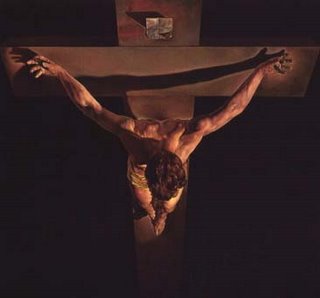
Next time your up in the middle of the night pondering what you can do as a Pastor, elder, District President, lay person, to fix the Church and make it prosperous, look to Christ crucified for you answer. It’s there nailed to the tree.

Wednesday, October 11, 2006

Chasubles

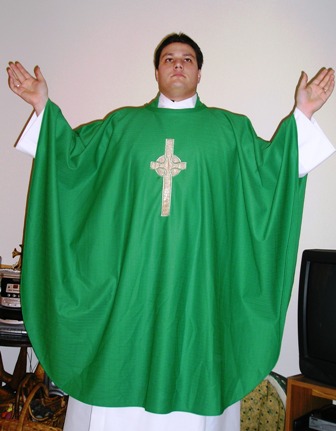
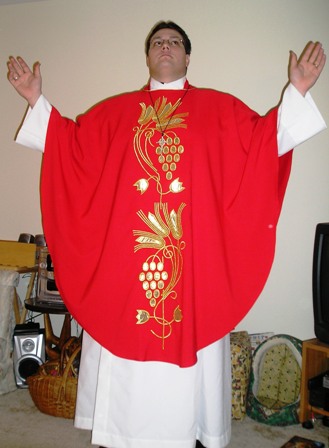
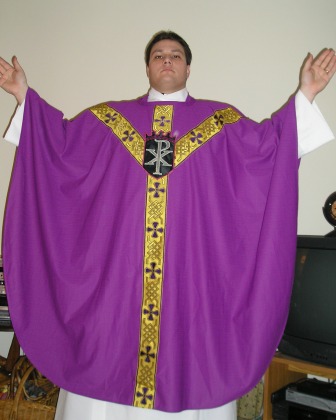
A very dear retired Pastor friend of mine, the Right Reverend, His Most Eminent Papal Bull, St. John of Hamilton, made a very generous and much appreciated gift of his chasubles to me. Below is a well written background of the history of Chasubles in the Bible and their use in modern Christian worship from www.kencollins.com I've also included pictures of the chasubles.

A chasuble, called a phelonion in Orthodox churches today, and a φελονης in 2 Timothy 4:13, is an ornate circular garment with a hole in the center for the wearer’s head. When worn, it reaches to the wearer’s wrists, so that if the wearer holds both arms straight out, the chasuble forms a semi-circle when viewed from the front or the back. The chasuble is the descendant of a first-century paenula that was worn as a coat by both sexes. Today it connotes solemnity and formality. The chasuble can be worn by the celebrant during a Eucharistic (communion) service. Sometimes the celebrant puts the chasuble on over other vestments as part of the Eucharistic ceremony. Chasubles are used in Lutheran churches, particularly outside the United States, as well as in Anglican and Roman Catholic churches.

The chasuble is always worn with a stole. Generally, the stole is under the chasuble. The stole and chasuble combination is the first-century equivalent of wearing a necktie and jacket. It is not appropriate to wear a chasuble in a service that does not include Communion (except for Good Friday and Holy Saturday services).

The Roman Empire had two modes of execution: non-citizens were thrown to wild animals, but citizens were beheaded with the sword. Therefore when Paul says that he escaped the lion’s mouth in 2 Timothy 4:17, he means he had successfully proved his Roman citizenship. In 2 Timothy 4:13, most translations vaguely refer to a garment or a cloak, but in the Greek, Paul asks Timothy to bring him the chasuble he had left behind in Troas. Since the chasuble was the mark of a Roman citizen, Paul apparently wanted to go out like one.

Therefore, when the celebrant is dressed in a chasuble, he is dressed like a Christian martyr who is ready to have his head chopped off for Christ.

Monday, October 09, 2006

Sermon for Pentecost 18

This link will take you to an audio recording of a sermon I delivered from the Gospel reading for Pentecost 18. It starts out a little bad and hard to hear, but it gets better after about 10 seconds. The sermon was delivered at my field education congregation, Beautiful Savior in Bridgeton, Missouri.

Mark 9:30-37 (English Standard Version)
Jesus Again Foretells Death, Resurrection

They went on from there and passed through Galilee. And he did not want anyone to know, for he was teaching his disciples, saying to them, "The Son of Man is going to be delivered into the hands of men, and they will kill him. And when he is killed, after three days he will rise." But they did not understand the saying, and were afraid to ask him.

Who Is the Greatest?
And they came to Capernaum. And when he was in the house he asked them, "What were you discussing on the way?" But they kept silent, for on the way they had argued with one another about who was the greatest. And he sat down and called the twelve. And he said to them, "If anyone would be first, he must be last of all and servant of all." And he took a child and put him in the midst of them, and taking him in his arms, he said to them, "Whoever receives one such child in my name receives me, and whoever receives me, receives not me but him who sent me."

Friday, September 29, 2006

Another Year for Thanksgiving to God for a Great Life.

Today is my 27th birthday. I have much to give thanks to God for and would like to share this (rather long, but very complete) prayer from The Lutheran Book of Prayer.

My Lord and my God, in You alone I live and move and have my being. Today I again mark the day of my birth and the beginning of my temporal life. In deep gratitude I also recall my spiritual birth in the waters of Holy Baptism as You reconciled me to Yourself and cleansed me of my sin. For all this I thank and praise You. This day reminds me, to Your praise, O God, my Creator, that I was not only born into this world, but also that You have bought me to a place where Your name is truly known, Your Word is taught in purity, and where, by Your means of grace, true faith is kindled. I thank You for the benefits that You have showered upon me, both for my life here and for my life yet to come, from the day of my birth to this very hour. You have nourished me and kept me. By Your holy angels, You have protected my life in ways I can hardly imagine, and You have provided my bodily needs of food, clothing, and shelter in rich measure. To this grace upon grace You have added Your Word, through which You deliver forgiveness, comfort, and peace for each day of my life. How wonderful are the works of Your hands, O Lord, and Your mercy rich beyond measure!

Let me never be mindful of my sinful beginning and my well-deserved punishment. But You have sought me out, the lost sheep; You have redeemed me, sanctified me, comforted me, governed me, and preserved me in my calling. Daily grant me forgiveness of sins as well as steadfastness in saving faith all the days You have prepared in advance for me, that I may serve You in true faith. In Jesus' name I pray. Amen.

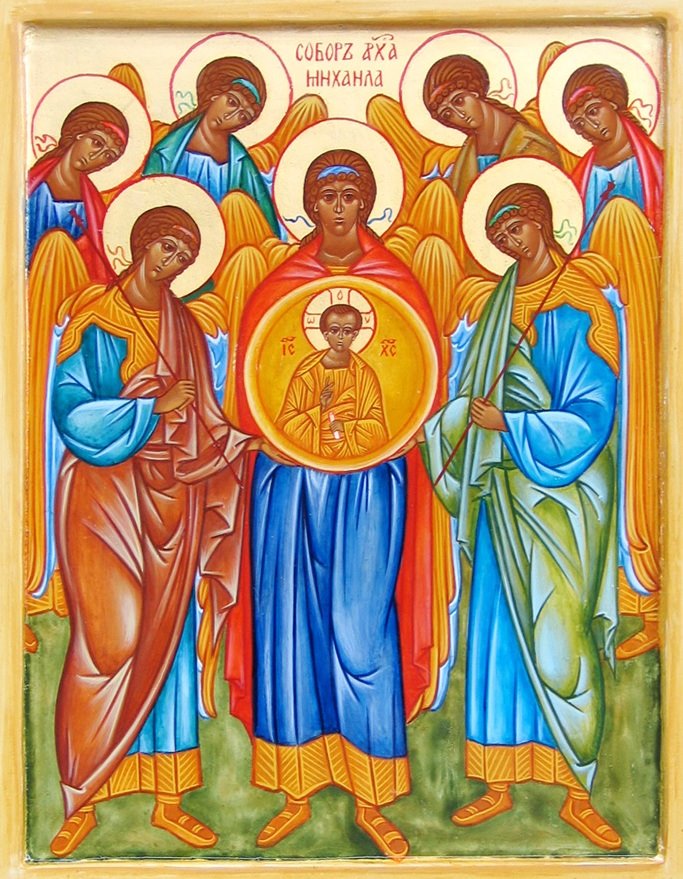
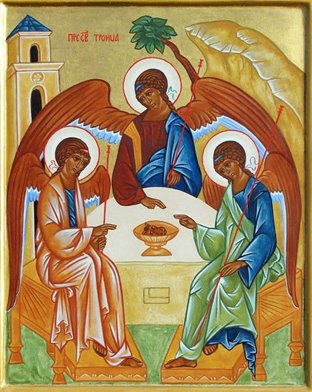
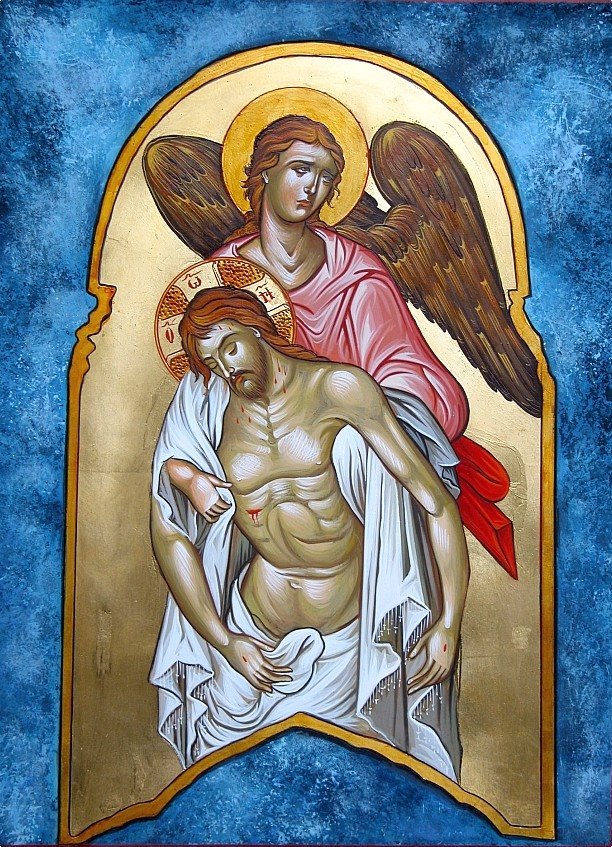
St. Michael and All Angels

The following information is excepted from St. Michael and All Angels by James Kiefer.
O everlasting God, who hast ordained and constituted the ministries of angels and men in a wonderful order: Mercifully grant that, as thy holy angels always serve and worship thee in heaven, so by thy appointment they may help and defend us on earth; through Jesus Christ our Lord, who liveth and reigneth with thee and the Holy Spirit, one God, for ever and ever.
lAmenl

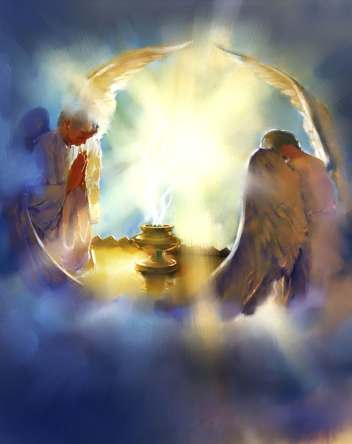
On the Feast of Michael and all Angels, popularly called Michaelmas, we give thanks for the many ways in which God's loving care watches over us, both directly and indirectly, and we are reminded that the richness and variety of God's creation far exceeds our knowledge of it.
The Holy Scriptures often speak of created intelligences other than humans who worship God in heaven and act as His messengers and agents on earth. We are not told much about them, and it is not clear how much of what we are told is figurative. Jesus speaks of them as rejoicing over penitent sinners (Lk 15:10). Elsewhere, in a statement that has been variously understood (Mt 18:10), He warns against misleading a child, because their angels behold the face of God. (Acts 12:15 may refer to a related idea.)

In the Hebrew Scriptures, it is occasionally reported that someone saw a man who spoke to him with authority, and who he then realized was no mere man, but a messenger of God. Thus we have a belief in super-human rational created beings, either resembling men in appearance or taking human appearance when they are to communicate with us. They are referred to as "messengers of God," or simply as "messengers." The word for a messenger in Hebrew is malach, in Greek, angelos, from which we get our word "angel" [Digression: angelion means "message, news" and euangelion means "good news = goodspell = gospel," from which we get our word "evangelist" used to mean a preacher of the Good News of salvation, and, more narrowly, one of the four Gospel-writers: Matthew, Mark, Luke, and John.]

By the time of Christ, Jewish popular belief included many specifics about angels, with names for many of them. There were thought to be four archangels, named Michael, Gabriel, Raphael, and Uriel. An alternative tradition has seven archangels (see Tobit 12:15 and 1 Enoch 20). Sometimes each archangel is associated with one of the seven planets of the Ptolemaic system (the moon, Mercury, Venus, the Sun, Mars, Jupiter, Saturn). Michael is associated with Saturn and Uriel with the Sun. The other pairings I forget, but I believe that you will find a list in the long narrative poem called "The Golden Legend," by Henry Wadsworth Longfellow. (I believe that a pairing is also offered in the opening chapters of the Proof of the Apostolic Preaching, by Irenaeus of Lyons, but I have not the work at hand.)

Michael (the name means "Who is like God?") is said to be the captain of the heavenly armies. He is mentioned in the Scriptures in Daniel 10:13,31; 12:1 (where he is said to be the prince of the people of Israel); in Jude 9 (where he is said to have disputed with the devil about the body of Moses); and in Revelation 12:7 (where he is said to have led the heavenly armies against those of the great dragon). He is generally pictured in full armor, carrying a lance, and with his foot on the neck of a dragon. (Pictures of the Martyr George are often similar, but only Michael has wings.)

Gabriel (the name means "God is my champion") is thought of as the special bearer of messages from God to men. He appears in Daniel 8:16; 9:21 as an explainer of some of Daniel's visions. According to the first chapter of Luke, he announced the forthcoming births of John the Baptist and of our Lord to Zachariah and the Virgin Mary respectively.


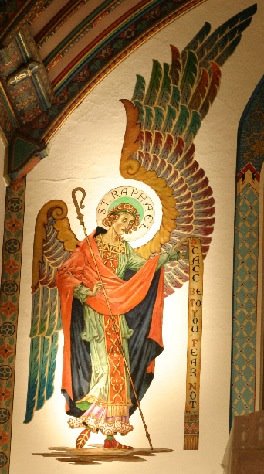
Raphael (the name means "God heals") is mentioned in the Apocrypha, in the book of Tobit, where, disguised as a man, he accompanies the young man Tobias on a quest, enables him to accomplish it, and gives him a remedy for the blindness of his aged father.

Uriel (the name means "God is my light" -- compare with "Uriah", which means "the LORD is my light") is mentioned in 4 Esdras.


It is thought by many scholars that the seven lamps of Revelation 4:5 are an image suggested by (among many other things) the idea of seven archangels.

What is the value to us of remembering the Holy Angels? Well, since they appear to excel us in both knowledge and power, they remind us that, even among created things, we humans are not the top of the heap. Since it is the common belief that demons are angels who have chosen to disobey God and to be His enemies rather than His willing servants, they remind us that the higher we are the lower we can fall. The greater our natural gifts and talents, the greater the damage if we turn them to bad ends. The more we have been given, the more will be expected of us. And, in the picture of God sending His angels to help and defend us, we are reminded that apparently God, instead of doing good things directly, often prefers to do them through His willing servants, enabling those who have received His love to show their love for one another.

Everything You Never Wanted to Know about Angels
The major post-New-Testament source for Christian ideas about angels is a writer (probably a fifth-century Syrian monk) who signed himself "Dionysius the Areopagite." His writings were taken to be those of a convert of the Apostle Paul, mentioned in Acts 17:34. Accordingly, when he wrote on angels (or any other theological subject), he was assumed to know what he was talking about. His writings had a considerable influence on the portrayal of angels in art and in the popular imagination.

What is a seraph?

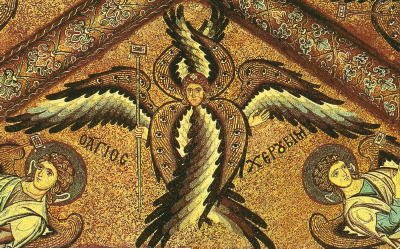
Seraphim are mentioned in the Bible in Isaiah's vision of the heavenly throne-room (Is 6:1-7), where the LORD is seated between two seraphim. (In Hebrew, most masculine nouns form the plural by adding "-im".) Each has six wings, and with two he covers his face, and with two he covers his feet, and with two he flies. Later writers identify these functions with poverty, chastity, and obedience. Poverty, in that he veils his face, a sign of humility. Chastity, in that he covers his feet, a standard Hebrew idiom (or euphemism) for the lower body, including the crotch. Obedience, in that he flies to carry out whatever commission he receives from God. The word "seraph" comes from a root meaning "to burn", and the word is used in Nu 21:6,8; Dt 8:15; Is 14:29; 30:6; where it is translated "fiery serpent." Probably the Hebrews pictured a seraph as a kind of fiery winged serpent or reptile.

What is a Cherub?

Cherubim are first mentioned in the Bible in Gen 3:24, where Adam and Eve are expelled from the Garden, and two cherubim are set at the gate to guard it, so that no one may enter. The Psalmist says of God:
He rode upon a cherub, and did fly; he came flying on the wings of the wind. (18:10)
thou that dwellest between the cherubim (80:1)
he sitteth between the cherubim; let the earth quake (99:1)
From this we infer that they were pictured and thought of as winged creatures flanking or supporting the throne of God.
Ancient Middle Eastern art regularly shows the throne of a king or a god flanked by, or sometimes resting on, two creatures. Typically, each creature has the body of a lion or a bull (often the front quarters of a lion, with claws, and the hind quarters of a bull, with hooves, or vice versa), the head of a man, and the wings of an eagle. We see these creatures, not only flanking a throne, but also flanking the gate or doorway of a city or a temple. They appear to be standard figures, performing the function of honor guards or that of guard dogs.

In Ex 25f and 36f, the Israelites are to make a chest called the Ark of the Covenant, and place on the lid statues of two cherubim, with their wings arching over and meeting in the middle. Aside from the fact that they had wings, we are not told anything about their appearance. It was apparently taken for granted that the Israelites already knew what a cherub was supposed to look like. It is a reasonable guess that they looked like the guard figures already standard in Middle Eastern art, as noted above.
The Ark represented the presence of God, and presumably the Israelites thought of the cherubim as guarding or flanking or supporting an invisible throne. Thus, the Ark gave two complementary messages. On the one hand, it said, "The LORD cannot be represented by a picture or statue. He is spirit, He is invisible. He is transcendant. The whole universe cannot contain Him." On the other hand, it said, "Here is the place where the LORD chooses to reveal Himself. This is the place toward which you are to direct your homage, this is the focus of your worship."
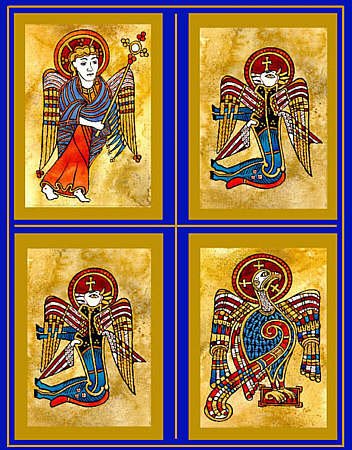
The prophet Ezekiel records two visions (Ez 1 and 10) in which the LORD appears to him, enthroned above four figures identified as cherubs. Each is said to have four faces, one facing in each direction, the face of a man, a lion, a bull, and an eagle.