Showing posts with label Liturgy and Vestments. Show all posts
Showing posts with label Liturgy and Vestments. Show all posts
Friday, September 10, 2010
Some thoughts after a long hiatus
I have not really blogged in a very long time. There have been many reasons for this, the biggest of which is just shear laziness and lack of interest. But, I think it important that I do begin to blog again. So, here is a thought after the long hiatus: Why can't western Christians (especially in the US) take their faith as seriously as many Muslims? I am not suggesting that we threaten death to anyone who criticizes us, or draws a blasphemous cartoon of the Lord of Life, Jesus Christ, or even martyrs one of our brethren in a country that is hostile to Christianity (most of the predominately Muslim eastern nations). But what I do think is missing is a healthy reverence for holy things. We grumble a bit when someone does this, but, by and large, we do not seem to care when the holy things of God are trodden upon. This sends a very clear message to those outside the one true faith, just as the reaction of many Muslims to the proposed Koran burning in Florida sends a very clear message. We are telling those outside of Christ's Church that we don't really believe what we say we do. When a female priest (sic) gives a dog communion it is a hard sell to nonbelievers that we really believe the bread and wine are Christ's Body and Blood or even represent our Lord and Savior. And just as bad a message is sent to the unbelieving world when we haphazardly celebrate the Lord's Supper in our churches in the LCMS. The clear and unmistakable message Western Christians are sending the world is that tolerance for falsehood, a casual, almost flippant attitude towards holy things, and the individual is our God. These things we will not tolerant any irreverence towards. These are the things we get really up tight about. And that is not right. Repent, Church of Christ! Hold dear and sacred those blessed gifts, those most holy things that have been given through the merit of Christ Jesus!
Monday, July 07, 2008
Divine Service 5 and Bearing with one another
Yesterday Good Shepherd celebrated the Holy Mysteries and received the Blessed gifts of Word and Sacrament in the 5th setting of the Divine Service from the Lutheran Service Book. I think it is very important for Lutheran pastors to present all of the services in the new hymnal on a regular basis. The reason for this: so that we all learn how to bear with one another.
Since I have been their pastor, Good Shepherd has used every service except Morning and Evening Prayer (and we will use those soon). In learning some of the new services I have gotten a lot of feedback, both good and bad about the services. That is good! In just about every service we have used I have had some people who absolutely loved them and others who absolutely hated them. I myself like some services better than others. This is a good lesson for Christians, it teaches us to bear with one another in love. And that is the lesson I try to teach my dear sheep. Sure, you may not like Divine Service 2, you may not like that I chant the Verbum in some verses, I may not like the less formal feel of Divine Service 4, but the Divine Service is not given for our entertainment, it is given as a vehicle for transporting the Word and Sacraments. As Christians who love one another, we gladly bear with a service we may not like for the benefit of our brothers and sisters. This is what Christian love and charity demands. And this is the beauty of Lutheranism. It is not about everyone doing their own thing, it is about everyone bearing with one another in love and patience. It is not about everyone doing what is right in their own eyes, but it is about bearing our crosses (and that may very well be the Lutheran Service Book or one of the services in it, or the liturgy in general). This is what it means to be Lutheran.
Since I have been their pastor, Good Shepherd has used every service except Morning and Evening Prayer (and we will use those soon). In learning some of the new services I have gotten a lot of feedback, both good and bad about the services. That is good! In just about every service we have used I have had some people who absolutely loved them and others who absolutely hated them. I myself like some services better than others. This is a good lesson for Christians, it teaches us to bear with one another in love. And that is the lesson I try to teach my dear sheep. Sure, you may not like Divine Service 2, you may not like that I chant the Verbum in some verses, I may not like the less formal feel of Divine Service 4, but the Divine Service is not given for our entertainment, it is given as a vehicle for transporting the Word and Sacraments. As Christians who love one another, we gladly bear with a service we may not like for the benefit of our brothers and sisters. This is what Christian love and charity demands. And this is the beauty of Lutheranism. It is not about everyone doing their own thing, it is about everyone bearing with one another in love and patience. It is not about everyone doing what is right in their own eyes, but it is about bearing our crosses (and that may very well be the Lutheran Service Book or one of the services in it, or the liturgy in general). This is what it means to be Lutheran.
Tuesday, January 15, 2008
Our Heavenly Heritage
In the late 19th and early 20th centuries, our country saw an explosion of immigration from several European countries. This is not really all that new, our country is, after all, technically made up of entirely of immigrants. What was interesting about that wave of immigration was that it presented a much larger scale problem for U.S. culture. The problem of assimilation. It is a problem we face with the increasing immigration from Mexico and Latin America today. How much of your native land do you hold on to and how much do you assimilate and become like the new land?
I think it is funny when older people, especially 1st or 2nd generation German-Americans, complain about Hispanic immigrants not learning the language. Truthfully, if there had not been two devastating wars in which Germany was a very big pain in the butt (to say the least), many Midwestern Lutheran Churches would still be having exclusively German services, there would be exclusive German neighborhoods, businesses, schools, libraries, etc.
This struggle with assimilation into a new culture is a very real struggle with Christians. We must never forget that, as Christians, this worldly truly is not our home. We are foreigners, strangers in a strange land. So, how much of our heavenly heritage do we hold on to and in what ways can we be like our present culture? Over and over again Scripture tells us that we cannot assimilate one bit. It is, in fact, impossible because we are dead to sin and alive to Christ.
It is part of the pastoral office to maintain our heavenly heritage. That's one very good reason why we do not simply do things the same on Sunday as we do the rest of the week. Our worship should be the last place we assimilate, and yet it is often the first place. My Fathers would weep to know of my limited knowledge of their native language. They would find it inconceivable that I do not have the German Small Catechism memorized. They would wonder if I were, in fact, truly Lutheran.
Perhaps our church Fathers would also weep to know of our limited knowledge of the native language of the Church, the divine liturgy. They, I'm sure, would find it inconceivable how little I know about the doctrines and struggles of the Church, perhaps they would even wonder, from all outward appearances, if I were even a Christian at all.
Our heavenly heritage is of great importance. While assimilation is a tempting thing, it is not an option for one who truly loves and longs to return to the Fatherland.
I think it is funny when older people, especially 1st or 2nd generation German-Americans, complain about Hispanic immigrants not learning the language. Truthfully, if there had not been two devastating wars in which Germany was a very big pain in the butt (to say the least), many Midwestern Lutheran Churches would still be having exclusively German services, there would be exclusive German neighborhoods, businesses, schools, libraries, etc.
This struggle with assimilation into a new culture is a very real struggle with Christians. We must never forget that, as Christians, this worldly truly is not our home. We are foreigners, strangers in a strange land. So, how much of our heavenly heritage do we hold on to and in what ways can we be like our present culture? Over and over again Scripture tells us that we cannot assimilate one bit. It is, in fact, impossible because we are dead to sin and alive to Christ.
It is part of the pastoral office to maintain our heavenly heritage. That's one very good reason why we do not simply do things the same on Sunday as we do the rest of the week. Our worship should be the last place we assimilate, and yet it is often the first place. My Fathers would weep to know of my limited knowledge of their native language. They would find it inconceivable that I do not have the German Small Catechism memorized. They would wonder if I were, in fact, truly Lutheran.
Perhaps our church Fathers would also weep to know of our limited knowledge of the native language of the Church, the divine liturgy. They, I'm sure, would find it inconceivable how little I know about the doctrines and struggles of the Church, perhaps they would even wonder, from all outward appearances, if I were even a Christian at all.
Our heavenly heritage is of great importance. While assimilation is a tempting thing, it is not an option for one who truly loves and longs to return to the Fatherland.
Thursday, December 06, 2007
Everything I need to know about Life in Christ, I learned in the Divine Service

1. There is one God, Father, Son and Holy Spirit and He has marked me as His own by the Cross of Christ. (Invocation)
2. I am sinful and deserve nothing from God except His wrath and punishment. If I don't believe and confess this I am a liar. (Confession)
3. Almighty God in His mercy has given His Son to die for me and for Christ's sake, He forgives me all of my sins. So that I would believe that more completely, God has called and ordained certain men to assure me of my temporal and eternal forgiveness. (Absolution)
4. As a forgiven child of God, I am invited and commanded to offer Him my prayer and praise. I may come into His divine and glorious presence for He has had mercy on me.(Service of the Word: Psalm/Introit, Kyrie, Hymn of Praise, Salutation and Collect of the Day)
5. Holy Scripture is the Word of the Lord, it does not contain some of the Word of the Lord, but is wholly, without doubt the complete Word of God, for this reason, I give God thanks. (Readings and their responses)
6. The Holy Gospel is Christ speaking. Where else can I go to find eternal life? Because of this the Church raises up her alleluias of praise. (Alleluia and Verse)
7. I believe in God the Father Almighty, and in One Lord Jesus Christ, and in the Holy Spirit. My faith is my own but it is the same as the Church throughout time. I cannot rely on anyone else's faith for my eternal salvation. (The Creed)
8. God's love for me is so great that He has given me a trained and ordained pastor and preacher, that His Word may be delivered to me in its truth and purity, that I may be convicted by God's Law and learn to live under it and that I may see with new sweetness and thanksgiving the life-giving and freeing Gospel of Jesus Christ. (Sermon)
9. Again, God calls me to come directly to Him in prayer. There is one Mediator between God and man, the one man, Jesus Christ. In His name I join with the Church, offering up prayers and petitions and thanksgiving for all things. (Prayer of the Church)
10. I am blessed to give God's Church a part of the blessings God has given me so that the work of the Gospel, namely the ministry of Word and Sacrament, may continue through His called and ordained servants. (Offering and Offertory)
11. The Lord is with us so we lift our hearts and give thanks, singing Him songs of praise, the very angelic hymn, which confesses our Holy Triune God to be almighty and having salvation in His wings. (Preface, Sanctus and Proper Preface)
12. God loves me so much that He has graciously taught me to pray. (Lord's Prayer)
13. Jesus Christ, the Son of God and the Son of Mary, has given me His own body and blood as He says in His Gospel which is the true and complete Word of God. The bread and wine that we receive as a testament of the Lord's death are truly what He says they are, that is Body and Blood given for our forgiveness. (Words of Institution)
14. The Peace of the Lord is found in His Eucharist which gives us Christ and the forgiveness of sins. (Pax Domini)
15. I recognize Christ in the Sacrament by the words of St. John the Baptizer and Forerunner: Lamb of God, You take away the sin of the world. (Agnus Dei)
16. Again, God in His all-availing love, has not left me to my own reason and experience to know that He comes to us in the body and blood, but has called and ordained certain men to give us and assure us that we receive the body and blood of Christ for the forgiveness of sins. (Distribution)
17. My response to God's mercy and kindness is a canticle of praise, either thanking our Lord and singing His praise, or asking Him to bless us with peace for the gift of His salvation, and coming before Him in prayer. (Post-Communion Canticle and Collect)
18. I leave this beautiful presence of the Lord, again reminded that it is in the name of the Triune God that I received and continue to receive all blessings, namely the forgiveness of sins, life and salvation. (Benediction)
19. Amen, that is, it shall be done.
Thursday, November 08, 2007
The Grammar of Devotional Living
 I have the great opportunity to teach three classes at West Michigan Lutheran High School in Kentwood. The class is on the Lutheran Confessions, but, since I am just "subbing" I was told I could teach on whatever topic I wanted to. Lutheran Devotional living is a very near and dear topic to me. I have found such great comfort in truly Lutheran devotional living, that is, centered around the good gifts of Word and Sacrament and focused on the cross of our Lord Jesus Christ.
Tomorrow I am going to introduce the kids to the idea that the Liturgy serves as a grammar for devotional living and the language of devotion. I remember when I was their age I could not for the life of me understand why the liturgy was so important, but, through my own study, I have come to value it as the grammatical framework for how we interact and speak to God. The Liturgy teaches us how to pray using God's own Word. It teaches us to deny ourselves and take up the cross. It teaches us to set our minds on things above and to fix our eyes on Jesus.
Like any grammatical system, the Liturgy is not something you can look at once and learn. It takes time and effort, but it is well worth it. In addition to teaching us the framework of worship and prayer, it has the unique characteristic of all languages in that it binds all the people who speak it. Our historic Liturgies give us that linguistic connection with all the other saints who have learned to speak this biblical language. So, when we say we in the Eucharistic liturgy that we say with angels and archangels and all the company of heaven the Sanctus, we are truly in holy conversation with the invisible and eternal Church; and the Liturgy is the grammar of the Church's language.
To me, these ideas are all very new, but I'm sure I'm not the first one to think of them. I pray that all my readers and especially all Lutherans, would strive to learn this beautiful heavenly language of the Liturgy, that we may always speak with the Holy Church through all ages.
Friday, October 12, 2007
Romans 14 and My Grandma
 One of the most influential people in my life is my Grandma Marian. She is such a rock of faithfulness and has been committed to the Lutheran faith for over 50 years (since she married my now at rest Grandpa, another titan of the faith). It was not easy for her to become a Lutheran. She went through adult instruction at a time when non-German, non-Lutherans were practically the same thing in the Midwest. She was seen as a dreaded Methodist outsider, what Gus Portokals from My Big Fat Greek Wedding would have called xeno. She came into this lifestyle from a broken home, a rarity in those days. She endured suspicious looks and German "converstations" about her for years. It was a long time until she felt accepted at her church. And yet she endured and grew in her faith. She now is a widow with severe arthritis and mobility issues, but she makes it to church. It is a priority, end of story.
It is no exaggeration to say that this dear woman's example is a very big reason I entered the seminary and am now serving the Lutheran Church as a pastor. And yet, we are two different Lutherans. My Grandma's church in the the greater Ft. Wayne area, so they always have field workers. I learned a lot from my Grandma about field work. She always told me while in seminary who important it was to make sure my alb was straight and ironed, how important it was not to talk to quietly or too loudly, how important it was to be polite to the old ladies in my congregation in St. Louis. She still tells me her opinions of the field workers. But I find that some of the things she finds odd and even questionable are things I do every day. For example. she has noticed more and more how these seminarians are always crossing themselves. How they bow all the time and walk around with their hands folded. It really made me realize that the things I do out of respect and a healthy piety can be objectionable, if not outright offensive to some of the pillars of the faith. Now, that does not mean that we should chuck all these "high-church" pious and reverent gestures, but it has made me very sensitive to the needs of people like my grandma: faithful men and women who have lived in their faith, who know more about being and living as a Lutheran than I do, people whose faith is firmly rooted in the gifts of God's Word and Sacrament.
They don't understand why us youngsters are so anxious to look "Roman," and why should they? They were taught by well-meaning, and perhaps some not-so-well-meaning, pastors that some things are just not for Lutherans. So, in my own congregation I continue to boldly live my own rather catholic Lutheran faith, but I try to keep in mind Romans 14 and remember that I am the weaker brother to my dear Grandma Marian:
As for the one who is weak in faith, welcome him, but not to quarrel
over opinions. One person believes he may eat anything, while the weak
person eats only vegetables. Let not the one who eats despise the one who
abstains, and let not the one who abstains pass judgment on the one who
eats, for God has welcomed him. Who are you to pass judgment on the servant
of another? It is before his own master that he stands or falls. And he will
be upheld, for the Lord is able to make him stand.
Saturday, October 06, 2007
What makes a bad teacher?
If you do not learn something from someone, does that make that person a bad teacher? I remember using that excuse often in school. "But Mom, it wasn't my fault I got a bafd grade. You don't understand, Mr./Mrs./Ms./Dr. So-and-So is just a bad teacher!"
Perhaps that line of reasoning is familiar with all of us to a certain extent. Perhaps, in some cases, it is true that we fail to learn because our teachers are bad. But, who's responsibility is it to learn? A bright and motivated student can learn something even from the most inept and incompetent teacher. And yet, isn't it the very essence of our sinful nature to try shift the blame off of our own short-comings?
I pose this question to encourage thought about the liturgy of the Church. The liturgy is a teacher, very old, very wise, but not always terribly "relevant" or "with it." I myself used those reasons for putting down and refusing to learn from the liturgy as a kno-it-all high school student. How many of us try to shift the blame for our poor church attendance, our lack of basic Biblical knowledge, our lack of evangelistic zeal, or even our less-than-sanctified living on the liturgy? It is convenient for us to say in our hearts, to our elders, or pastors, "I would go to church more often if it wasn't so BORING with the same old liturgy every week!"
The truth of the matter is simple: it is not the liturgies fault that you are a sinner! It is not the liturgies fault that you don't find it entertaining! It is not the liturgies fault that you don't follow along! it is not the liturgies fault that you don't understand it! It is YOUR fault and mine! The liturgy is a beautiful teacher of God's Holy Word. When you blame the liturgy for not being interesting, you are blaming God's Word. Instead of constantly pointing to the perceived deficiencies of your teacher, look at yourself. What is it about the liturgy that you really don't like? Could it be that it does not revolve around you? Could it be that it makes you feel uncomfortable, what with all the confessing of sins?
Sometimes the teacher is at fault, but God's Word is never at fault. Be a better student and you will find that old teacher is not nearly as irrelevant as you once thought.
Perhaps that line of reasoning is familiar with all of us to a certain extent. Perhaps, in some cases, it is true that we fail to learn because our teachers are bad. But, who's responsibility is it to learn? A bright and motivated student can learn something even from the most inept and incompetent teacher. And yet, isn't it the very essence of our sinful nature to try shift the blame off of our own short-comings?
I pose this question to encourage thought about the liturgy of the Church. The liturgy is a teacher, very old, very wise, but not always terribly "relevant" or "with it." I myself used those reasons for putting down and refusing to learn from the liturgy as a kno-it-all high school student. How many of us try to shift the blame for our poor church attendance, our lack of basic Biblical knowledge, our lack of evangelistic zeal, or even our less-than-sanctified living on the liturgy? It is convenient for us to say in our hearts, to our elders, or pastors, "I would go to church more often if it wasn't so BORING with the same old liturgy every week!"
The truth of the matter is simple: it is not the liturgies fault that you are a sinner! It is not the liturgies fault that you don't find it entertaining! It is not the liturgies fault that you don't follow along! it is not the liturgies fault that you don't understand it! It is YOUR fault and mine! The liturgy is a beautiful teacher of God's Holy Word. When you blame the liturgy for not being interesting, you are blaming God's Word. Instead of constantly pointing to the perceived deficiencies of your teacher, look at yourself. What is it about the liturgy that you really don't like? Could it be that it does not revolve around you? Could it be that it makes you feel uncomfortable, what with all the confessing of sins?
Sometimes the teacher is at fault, but God's Word is never at fault. Be a better student and you will find that old teacher is not nearly as irrelevant as you once thought.
Saturday, July 28, 2007
A Little Background on the Lutheran/Reformed use of the Litany
I did a bit of research for the perseverance podcast and found this web article:
In the first period of the Wittenberg Reformation processions and litanies were retained, although they were discarded by 1525. Four years later, however, a revised litany was restored in Evangelical worship by Luther himself, the immediate occasion being a threatened invasion of the Turks. He evidently published a separate German version of this litany, although no copy of this edition is known to be extant, but there is no ground for assuming that he issued the Latin text of it as he proposed to do. The German litany was also appended to the third edition of his smaller catechism, but was later omitted, although it then found its way into the hymnals, doubtless with its author's approval. The Latin version, in like manner, was almost certainly contained in the hymnal of Klug published in 1529 and no longer extant. It may well have included the German version as well, like the later editions of the work and a number of other hymnals of the same period. The extension of the litany through middle and north Germany by means of the hymn-books was rapid, but it was comparatively rarely found, on the other hand, in southern or southwestern German hymnody. There, however, it was spread by the church orders, the more important ones all containing it. The original Lutheran litany was closely similar to, the Roman Catholic Litany of the Saints, except that all invocations of the saints, as well as petitions for the pope and the dead, were omitted. On the other hand, the petitions are more specialized and more concrete than in the older litany, which is, nevertheless, far the richer.
In the northern and central parts of Germany no uniformity whatever prevailed in the time of the recitation of the litany. Wednesday and Friday were, on the whole, the favorite days, although it might also be recited on Tuesday, Sunday festivals, and at vespers on Saturday. Local usage in many cases prescribed it for special days, while numerous church orders required it to be said occasionally, although no special day was designated. The place which the litany occupied in the North and Middle German liturgy likewise varied. It might be recited alone, either in the morning or the evening, after the lesson, epistle, or sermon, and before or during the communion. An equal lack of uniformity prevailed in southern and southwestern Germany, but there the litany, in harmony with the intention of Luther, retained its original character of a penitential prayer more than in the north, so that in Strasburg it followed the confession and absolution. The litany was subject, furthermore, to numerous local modifications, petitions being inserted or omitted practically at pleasure.
In Wittenberg the German litany was chanted by the choir-boys, while the congregation sang the responses, although ultimately one part of the choir chanted the petitions and the other responded. The Latin litany was sung only in the latter fashion. In the seventeenth century the Latin litany was discarded altogether, and in case there was a trained choir, the pastor, kneeling or standing with his face toward the altar, intoned the petition, while the congregation, led by the choir, sang the responses. If for any reason the litany was not sung, it might be recited or read. These modes of repeating the litany gradually supplanted the singing of it, but on the whole, though it is still retained in almost all modern German liturgies, it has lost its hold in great measure on the congregations because of its monotony.
The Reformed Church had little sympathy with the litany, and rejected it almost without exception, so that wherever Calvinism gained supremacy over Lutheranism, the litany was abolished.
The Moravians have two litanies, the "Church Litany " and the "Litany of the Life, Passion, and Death of Jesus Christ." The former is used in a double form, a shorter version having been made in 1873, while the latter is derived from the "Litany of Wounds" composed by Zinzendorf in 1744.
(P. DREWS.)
The litany of the English Book of Common Prayer was originally intended to be a distinct office. A rubric in the first prayer-book (1549) ordered it to be said on Wednesdays and Fridays, before the communion-office. It was then placed after the communion-office, and in 1552 put in the place it now occupies, with the direction that it was to be "used upon Sundays, Wednesdays, and Fridays, and at other times when it shall be commanded by the ordinary." The clause in Edward's prayerbook, "From the tyranny of the Bishop of Rome and all his detestable enormities," was omitted in 1559.
In the first period of the Wittenberg Reformation processions and litanies were retained, although they were discarded by 1525. Four years later, however, a revised litany was restored in Evangelical worship by Luther himself, the immediate occasion being a threatened invasion of the Turks. He evidently published a separate German version of this litany, although no copy of this edition is known to be extant, but there is no ground for assuming that he issued the Latin text of it as he proposed to do. The German litany was also appended to the third edition of his smaller catechism, but was later omitted, although it then found its way into the hymnals, doubtless with its author's approval. The Latin version, in like manner, was almost certainly contained in the hymnal of Klug published in 1529 and no longer extant. It may well have included the German version as well, like the later editions of the work and a number of other hymnals of the same period. The extension of the litany through middle and north Germany by means of the hymn-books was rapid, but it was comparatively rarely found, on the other hand, in southern or southwestern German hymnody. There, however, it was spread by the church orders, the more important ones all containing it. The original Lutheran litany was closely similar to, the Roman Catholic Litany of the Saints, except that all invocations of the saints, as well as petitions for the pope and the dead, were omitted. On the other hand, the petitions are more specialized and more concrete than in the older litany, which is, nevertheless, far the richer.
In the northern and central parts of Germany no uniformity whatever prevailed in the time of the recitation of the litany. Wednesday and Friday were, on the whole, the favorite days, although it might also be recited on Tuesday, Sunday festivals, and at vespers on Saturday. Local usage in many cases prescribed it for special days, while numerous church orders required it to be said occasionally, although no special day was designated. The place which the litany occupied in the North and Middle German liturgy likewise varied. It might be recited alone, either in the morning or the evening, after the lesson, epistle, or sermon, and before or during the communion. An equal lack of uniformity prevailed in southern and southwestern Germany, but there the litany, in harmony with the intention of Luther, retained its original character of a penitential prayer more than in the north, so that in Strasburg it followed the confession and absolution. The litany was subject, furthermore, to numerous local modifications, petitions being inserted or omitted practically at pleasure.
In Wittenberg the German litany was chanted by the choir-boys, while the congregation sang the responses, although ultimately one part of the choir chanted the petitions and the other responded. The Latin litany was sung only in the latter fashion. In the seventeenth century the Latin litany was discarded altogether, and in case there was a trained choir, the pastor, kneeling or standing with his face toward the altar, intoned the petition, while the congregation, led by the choir, sang the responses. If for any reason the litany was not sung, it might be recited or read. These modes of repeating the litany gradually supplanted the singing of it, but on the whole, though it is still retained in almost all modern German liturgies, it has lost its hold in great measure on the congregations because of its monotony.
The Reformed Church had little sympathy with the litany, and rejected it almost without exception, so that wherever Calvinism gained supremacy over Lutheranism, the litany was abolished.
The Moravians have two litanies, the "Church Litany " and the "Litany of the Life, Passion, and Death of Jesus Christ." The former is used in a double form, a shorter version having been made in 1873, while the latter is derived from the "Litany of Wounds" composed by Zinzendorf in 1744.
(P. DREWS.)
The litany of the English Book of Common Prayer was originally intended to be a distinct office. A rubric in the first prayer-book (1549) ordered it to be said on Wednesdays and Fridays, before the communion-office. It was then placed after the communion-office, and in 1552 put in the place it now occupies, with the direction that it was to be "used upon Sundays, Wednesdays, and Fridays, and at other times when it shall be commanded by the ordinary." The clause in Edward's prayerbook, "From the tyranny of the Bishop of Rome and all his detestable enormities," was omitted in 1559.
Thursday, July 26, 2007
The Litany
Has anyone used the musical setting to the Litany in LSB? I am thinking of offering it everyday at noon (at least make it known that I will be saying/singing it). I have found that the musical setting is very beautiful. Any thoughts for other uses for the Litany regularly in the Church's worship?
Friday, June 29, 2007
Defense of the Crucifix in Lutheranism and Christianity
Rev. Paul McCain brought this to my attention through his blog. The Wisconsin Synod has given a very good answer to "Isn't that too CATHOLIC?!?!" in regards to the crucifix of our Lord Jesus Christ. Give it a read!

Wednesday, October 11, 2006
Chasubles
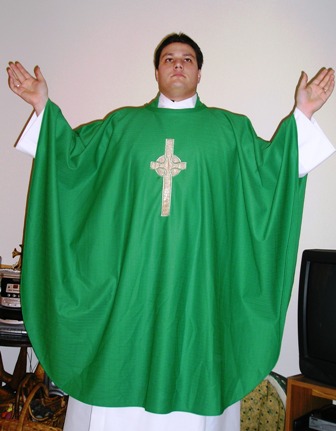
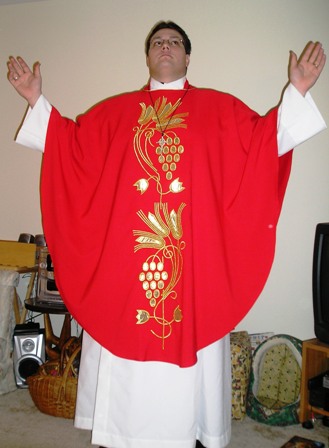
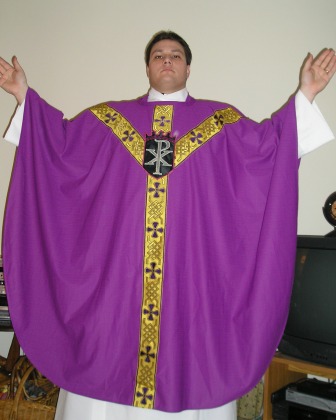
A very dear retired Pastor friend of mine, the Right Reverend, His Most Eminent Papal Bull, St. John of Hamilton, made a very generous and much appreciated gift of his chasubles to me. Below is a well written background of the history of Chasubles in the Bible and their use in modern Christian worship from www.kencollins.com I've also included pictures of the chasubles.
A chasuble, called a phelonion in Orthodox churches today, and a φελονης in 2 Timothy 4:13, is an ornate circular garment with a hole in the center for the wearer’s head. When worn, it reaches to the wearer’s wrists, so that if the wearer holds both arms straight out, the chasuble forms a semi-circle when viewed from the front or the back. The chasuble is the descendant of a first-century paenula that was worn as a coat by both sexes. Today it connotes solemnity and formality. The chasuble can be worn by the celebrant during a Eucharistic (communion) service. Sometimes the celebrant puts the chasuble on over other vestments as part of the Eucharistic ceremony. Chasubles are used in Lutheran churches, particularly outside the United States, as well as in Anglican and Roman Catholic churches.
The chasuble is always worn with a stole. Generally, the stole is under the chasuble. The stole and chasuble combination is the first-century equivalent of wearing a necktie and jacket. It is not appropriate to wear a chasuble in a service that does not include Communion (except for Good Friday and Holy Saturday services).
The Roman Empire had two modes of execution: non-citizens were thrown to wild animals, but citizens were beheaded with the sword. Therefore when Paul says that he escaped the lion’s mouth in 2 Timothy 4:17, he means he had successfully proved his Roman citizenship. In 2 Timothy 4:13, most translations vaguely refer to a garment or a cloak, but in the Greek, Paul asks Timothy to bring him the chasuble he had left behind in Troas. Since the chasuble was the mark of a Roman citizen, Paul apparently wanted to go out like one.
Therefore, when the celebrant is dressed in a chasuble, he is dressed like a Christian martyr who is ready to have his head chopped off for Christ.
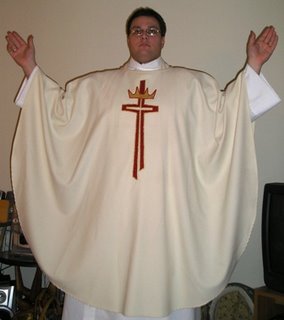

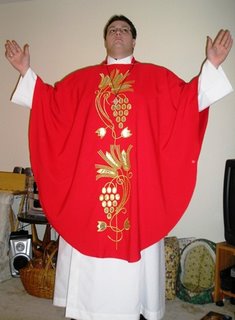

A chasuble, called a phelonion in Orthodox churches today, and a φελονης in 2 Timothy 4:13, is an ornate circular garment with a hole in the center for the wearer’s head. When worn, it reaches to the wearer’s wrists, so that if the wearer holds both arms straight out, the chasuble forms a semi-circle when viewed from the front or the back. The chasuble is the descendant of a first-century paenula that was worn as a coat by both sexes. Today it connotes solemnity and formality. The chasuble can be worn by the celebrant during a Eucharistic (communion) service. Sometimes the celebrant puts the chasuble on over other vestments as part of the Eucharistic ceremony. Chasubles are used in Lutheran churches, particularly outside the United States, as well as in Anglican and Roman Catholic churches.
The chasuble is always worn with a stole. Generally, the stole is under the chasuble. The stole and chasuble combination is the first-century equivalent of wearing a necktie and jacket. It is not appropriate to wear a chasuble in a service that does not include Communion (except for Good Friday and Holy Saturday services).
The Roman Empire had two modes of execution: non-citizens were thrown to wild animals, but citizens were beheaded with the sword. Therefore when Paul says that he escaped the lion’s mouth in 2 Timothy 4:17, he means he had successfully proved his Roman citizenship. In 2 Timothy 4:13, most translations vaguely refer to a garment or a cloak, but in the Greek, Paul asks Timothy to bring him the chasuble he had left behind in Troas. Since the chasuble was the mark of a Roman citizen, Paul apparently wanted to go out like one.
Therefore, when the celebrant is dressed in a chasuble, he is dressed like a Christian martyr who is ready to have his head chopped off for Christ.


Wednesday, September 27, 2006
Maybe I'm a little over-confident...but
Ok, I know that the i's aren't all dotted and the t's aren't all crossed yet, but I feel pretty sure that I am going to get through this year, receive a call and be ordained. So, I ordered my stoles. My vicarage congregation took up a collection for a set of stoles for me as a farewell gift. They are so generous and loving! So, I got my stoles today from a terrific company in Canton, Ohio, Kanel Brothers. They have some of the best customer service I have ever experienced and very reasonable prices for custom made vestments.
So, here they are.

Advent Stole, Behold, the Lamb of God who takes away the sin of the world! The star that guided the wise men to the Christ.
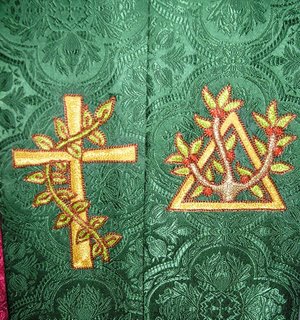
The vine that comes from the Branch of the Cross, new growth and the fruits of faith that comes from our baptism and the name of the Triune God.
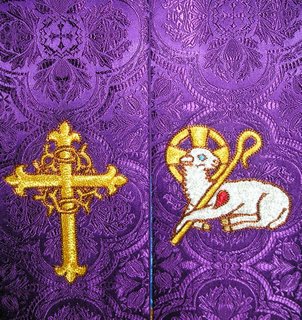
The suffering and humiliation of Christ's Passion, a Lamb before the slaughter. I really like the parallel between this stole and the advent stole.
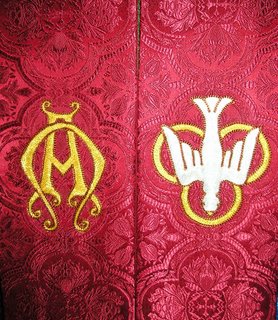
The Beginning and the End, the Holy Spirit descending in the symbol of the Trinity.

I like these two almost mirror images. The right cross is for the new-born Christ, with His Passion and Resurrection before Him, the left cross signifies His Easter Triumph over death, the devil and the grave.
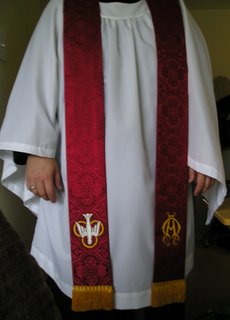
Front view of the red stole.
So, here they are.

Advent Stole, Behold, the Lamb of God who takes away the sin of the world! The star that guided the wise men to the Christ.

The vine that comes from the Branch of the Cross, new growth and the fruits of faith that comes from our baptism and the name of the Triune God.
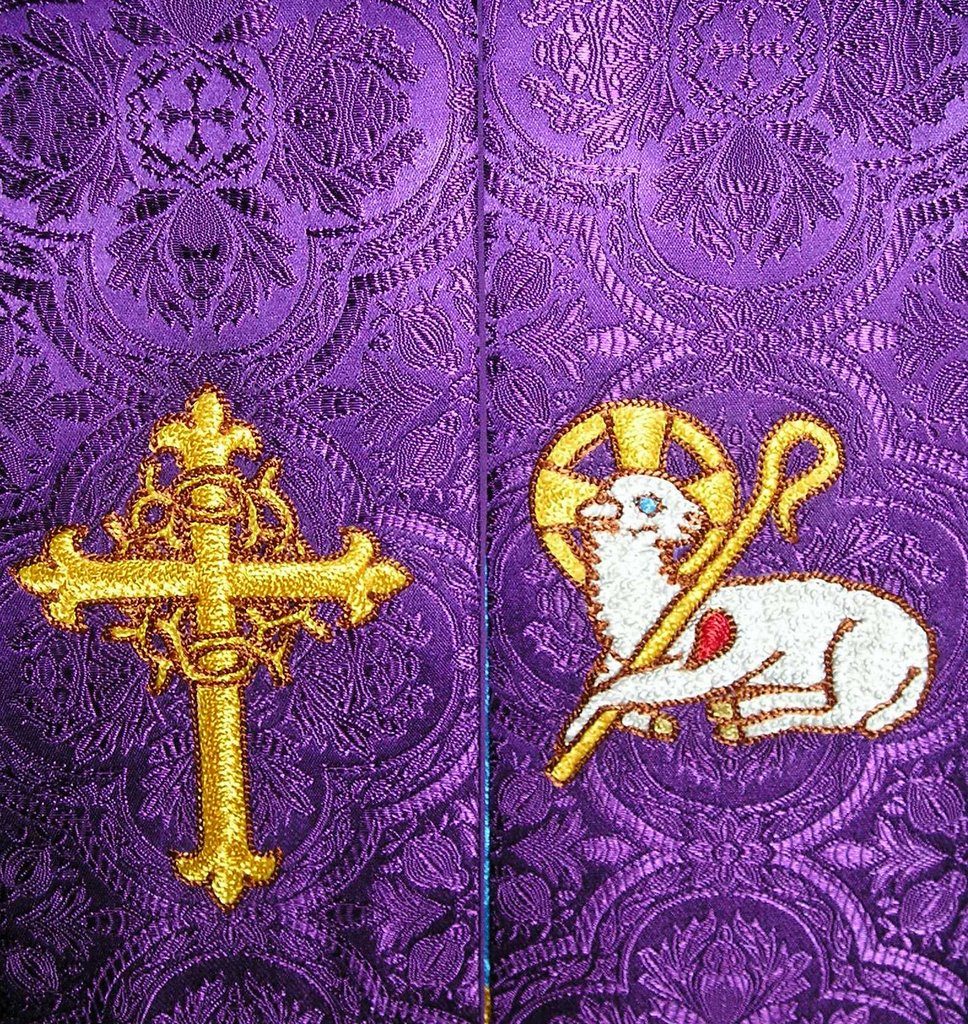
The suffering and humiliation of Christ's Passion, a Lamb before the slaughter. I really like the parallel between this stole and the advent stole.

The Beginning and the End, the Holy Spirit descending in the symbol of the Trinity.

I like these two almost mirror images. The right cross is for the new-born Christ, with His Passion and Resurrection before Him, the left cross signifies His Easter Triumph over death, the devil and the grave.
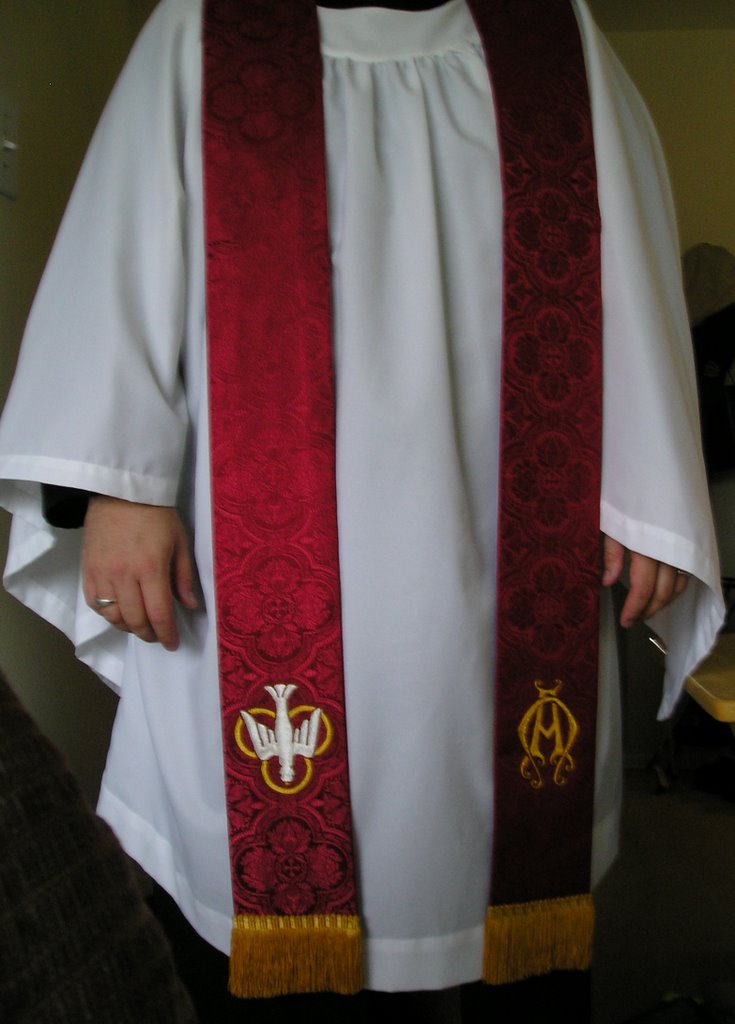
Front view of the red stole.
Sunday, June 18, 2006
Interesting Discussions
Rev. Paul McCain has stumbled into (but more likely kicked!) a liturgical hornets' nest on his blog Cyberbrethren. Interesting discusion, and as one might suspect when dealing with a subject so close to the heart and the soul as worship practices, very heated. Readers of this blog will note that I lean pretty far over into the camp of "chancel prancers." I'm not ashamed of that. There is great meaning and depth in historic forms of liturgical worship. And worship does form and shape doctrine, just as the kind of clothes one wears forms and shapes not only others opinions of him, but his own view of himself.
What I like the best about Pastor McCain's discussion is the idea that it is not right to radically change practices of worship in either direction. I'm not talking one pastor who chants the liturgy and another who speaks it. I'm talking no vestments, might-as-well-be-Baptist Lutherans vs. Lutherans who present worship styles that suggest prayer to saints, an unhealthy veneration of the Blessed Virgin (which some people might think calling Mary "the Blessed Virgin" is unhealthy), and an attitude of why-did-we-ever-leave-let's-be-more-Catholic-than the pope.
I fear that vast differences in worship practice in the LCMS is terribly confusing to laity, devisive among clergy, and in general do not in any way aid or adourn the Gospel of Christ. But, can anything be done about it? I worry about the possibility of a split in the LCMS a lot, but is there an alternative? Would it be better to split rather than calling ourselves a Synod? Isn't that kind of hypocritical? Just some thoughts.
What I like the best about Pastor McCain's discussion is the idea that it is not right to radically change practices of worship in either direction. I'm not talking one pastor who chants the liturgy and another who speaks it. I'm talking no vestments, might-as-well-be-Baptist Lutherans vs. Lutherans who present worship styles that suggest prayer to saints, an unhealthy veneration of the Blessed Virgin (which some people might think calling Mary "the Blessed Virgin" is unhealthy), and an attitude of why-did-we-ever-leave-let's-be-more-Catholic-than the pope.
I fear that vast differences in worship practice in the LCMS is terribly confusing to laity, devisive among clergy, and in general do not in any way aid or adourn the Gospel of Christ. But, can anything be done about it? I worry about the possibility of a split in the LCMS a lot, but is there an alternative? Would it be better to split rather than calling ourselves a Synod? Isn't that kind of hypocritical? Just some thoughts.
Friday, June 02, 2006
On incense, chanting, bowing, and other things "Taboo"
 Why are these things taboo in most mainstream, contemporary Lutheran circles? We have had it instilled in our collective psyche from the first moment the hammer hit the nail at Wittenberg that we were possibly wrong. Then, as the peasants threatened to tear the world apart, we got that feeling even more strongly. And all the time we question and second guess ourselves. Did we go far enough? Can we really do what we have done? Is it ok to put the Bishop on a boat and send him across the Mississippi?
We have a lot of fears in the Lutheran Church—Missouri Synod. Fears of being “too Catholic.” Fears of not being “relevant.” Fears of being “too evangelical.” Fears that we somehow are not right, even though we know we are.
We did not leave the Catholic Church, we reformed her. By remaining true to the Gospel and standing up to Satan and his lies, we have been given the mantle of the Catholic Church. There are many things that did not need reforming. Liturgical worship was and is a blessing. The use of incense and other tools to aid us in attaining a reverent and awe-filled attitude in the presence of the Living God are blessings. Making the sign of the cross as a remembrance of one’s baptism is a blessing. Bowing out of respect and awe for the holiness of God as He gives us His holy Body and Blood are a natural and healthy response.
So, my Lutheran brethren (and sisteren!), stop looking over your shoulder to see what all the other “reform” minded people are doing. Be Lutheran! Be Evangelical! Be Catholic! Be the Church! Be a beacon of the most precious and beautiful of all of God’s gifts: The Holy Gospel of Jesus Christ. (And don’t worry about the capital letters!)
Tuesday, February 07, 2006
A Pondering...

I just had a thought, a pondering really, and it struck me, "Jim, this is the kinda thing you should put in a blog!" So. . . here it is:
Is there a real need, desire, want for more "relevant" Christianity(i.e., contemporary music/worship, worship leaders, big screens and in general audio/visual extravaganzas)? If this is the case, is it right to manipulate and bend church tradition to fit human needs and desires?
-OR-
Is the need only perceived by well-meaning, or maybe not so well-meaning, theologians, pastors, or other church leaders? If this is the case, has that created a perceived need and craving amongst the various sheep in the flock of Christ's church? Example: I have a cousin who was brought up with a strict rule against sweets and sugary foods. The only reason she desired it was because her older cousins and siblings who were not under this rule persuaded her that it was needed and to indulge in this potentially harmful and certainly unhealthy treat, thus creating an unhealthy and unnecessary obsession with it.
Ok, the questions are out there (granted, they are a bit biased.)
Talk amongst yourselves.
Subscribe to:
Posts (Atom)